Reading the manuscript with AI
Sgeulai can read your manuscript and build the Story Bible from it. The important thing to understand is not how it works but what it is allowed to write down without asking.
Reading with AI is part of Sgeulai Pro, whichever engine does the reading — Claude with your own key, or Apple's on-device model. Choosing a command without Pro opens the Sgeulai Pro window first, before you are asked about anything leaving your device. The 14-day trial covers it. See Sgeulai Pro.
Everything writes straight in
When Sgeulai reads your manuscript, everything it finds — facts, like a character existing or two people being related, and interpretive readings, like what someone is afraid of or what a scene is for — writes straight into the Story Bible. There is no review queue to work through first.
The safety net: every raw response is archived
Before anything is written, the model's raw response is saved to disk — inside Sgeulai's own container's Application Support folder, in a subfolder named "AI Extractions." If a run writes something wrong, or a response fails to parse and the section is skipped, the text the model actually returned is still there — and Replay Archived AI Results… (below) reads it straight back into the Story Bible without paying for the API call again.
Replay Archived AI Results…
Re-reads responses from an earlier run into the Story Bible. No API call is made and nothing is charged — the tokens were paid for the first time. Use it when a run's results were lost: cleared by a replacing run, dropped by a bug, or never written because the response failed to decode.
The picker groups responses into runs by when they were saved, and preselects the most recent one, which is usually the one worth recovering. Only the passes that carry a Story Bible can be replayed, along with the scene split and Crush Report a full read saves beside them; anything else, a cast index say, is a different shape and is shown greyed out. The newest Crush Report in the run you pick rewrites the report note.
A full project backup is also saved automatically before a replacing run — see The Tools menu ▸ Show Automatic Backups.
AI Readings
Propose Scene Splits… (below) is the one AI command left that still queues its output here for review rather than writing it straight in — a proposed split changes the shape of the book, not just a field, so it waits for Accept. If you have older readings or new-record candidates already sitting in AI Readings from before this change, they're still there and still reviewable exactly as before; nothing already queued was removed.
Which engine reads it
With a Claude API key set, Anthropic's Claude does the reading — the richest extraction available. Without one, Sgeulai falls back to the on-device Apple Intelligence model, and nothing leaves your Mac. See The Claude API key for getting one, paying for it, and exactly which of the commands below need it.
The manuscript's menu shows which engine is active as a line at the bottom: Engine: ….
The three ways to run it
All of them show the same progress sheet while they work — the section being read, out of how many, and what is being extracted. A long manuscript is sent in sections rather than whole, which is why the count is there.
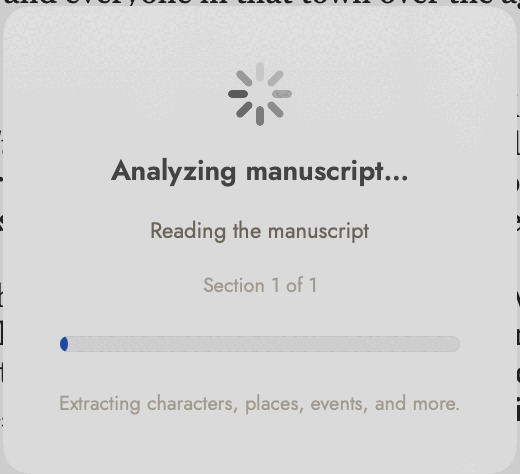 "Section 1 of 1" means the whole manuscript fitted in
one request. A longer book counts up.
"Section 1 of 1" means the whole manuscript fitted in
one request. A longer book counts up.
Analyze Manuscript with AI…
The first read. Builds the Story Bible from a manuscript that has not been read before — new Characters, Locations, Events, Organizations, Themes, and Objects, plus interpretive readings on them, all write straight in.
Re-analyze, Replacing Previous AI Results…
Clears what earlier AI runs of that manuscript wrote, then reads it again and writes the results straight in, the same as a first analysis. Records you typed or imported are kept. Use this when the manuscript has changed enough that the old reading is wrong rather than incomplete.
Re-analyze, Inserting New AI Results…
Two passes in one run. First, the same read as Analyze Manuscript with AI…, looking for Characters, Locations, Events, Organizations, and Objects the Story Bible doesn't have yet. Then it goes back over the records the manuscript already has and fills the fields that Compact and Necessities show, from what the prose says. Both passes write straight in. Nothing is deleted, but a field that already has a different answer is overwritten, not just filled in when blank.
Because it reads the whole manuscript for new records, this costs about what a first analysis or a replacing run does — no longer the lighter, blanks- only pass it once was.
Find Only What’s Missing…
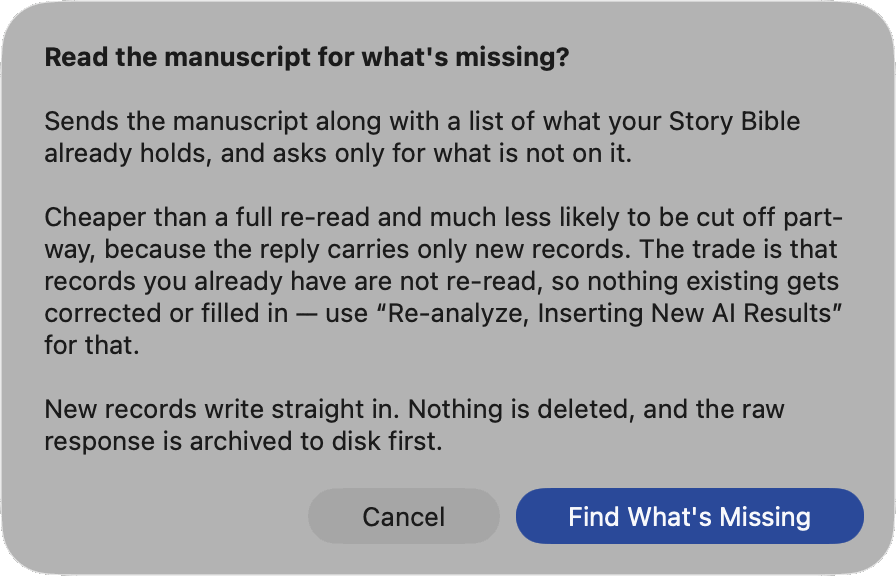 Every AI command in this menu explains its own trade
before it runs. This one's is in the third paragraph: cheap and safe, but it
will not fix anything you already have.
Every AI command in this menu explains its own trade
before it runs. This one's is in the third paragraph: cheap and safe, but it
will not fix anything you already have.
The cheap re-read. It sends the manuscript along with a list of what your Story Bible already holds — every Character, Location, Event, Organization, Theme and Object by name — and asks the model to report only what is not on that list.
Two things follow from that. It costs less, because the reply carries only new records rather than the whole cast again; and it is much less likely to be cut off part-way, since the length limit is spent on what you don’t have instead of what you do. On a book you have already analysed once, this is the one to reach for when you have added chapters and want to know who is new.
The trade is that records you already have are not re-read. Nothing existing gets corrected, enriched, or filled in — for that, use Re-analyze, Inserting New AI Results…. Relationships and dates are still reported, including ones that connect a new record to an existing one, which is often the most useful thing a second pass finds.
One narrow exception: a chapter or scene with no in-story date — when it happens in the book’s own time, not when it was written — is asked for just that one field. It is the only existing-record field this run ever touches, kept this small on purpose so the command stays the cheap, narrow one; everything else about an existing chapter or scene still waits for Re-analyze, Inserting New AI Results….
New records write straight in, nothing is deleted, and the raw response is archived to disk first like every other run. If the model reports something you already have anyway, it is dropped on the way in rather than duplicated.
Scenes, before it reads
A book imported as chapters only has no scenes, and a good deal of what the analysis reads is kept per scene — what each one is for, what turns in it. So Analyze Manuscript with AI… and both Re-analyze commands begin, when Claude is the engine, by giving every scene-less chapter its scenes:
- A chapter with its own break marks is split on them, free.
A line holding nothing but a row of asterisks (
* * *,***), dashes, a lone#,⁂or§is taken as the break you already put there. Nothing is sent for that chapter, and the mark itself is dropped. - A chapter with no marks goes to Claude, one chapter at a time, asking only where each scene genuinely starts — a jump in time, a change of place or point of view — not for any of its text. The chapter is then cut at those points from your own prose, so no word changes; if a start can't be found exactly, that chapter is left as it was. A chapter that reads as one continuous scene stays one.
Unlike Propose Scene Splits, this writes straight in, because the read that follows needs the scenes to exist. A project backup, with your prose in it, is saved first. The run's closing alert says how many chapters it split, and how many of those were on your own marks. Find Only What’s Missing doesn't do this, and neither does the on-device model.
Propose Scene Splits…
The same scene-finding, as a separate command that waits for your review: chapters that have never been split into scenes get a proposed set of scene breaks, each cut from the chapter's own text at the point the model says the scene starts, with a short title. Nothing is created outright — proposals wait for review the same way AI Readings do, and accepting one is what actually turns the chapter's prose into real scene records.
The Crush Report
A full read with Claude ends by writing a Story Bible Note called Crush Report: ‹manuscript title› — the page an author wants before sending a book out, in three lists:
- Contradictions — where the book disagrees with itself: an age that doesn't add up across the years the book says passed, a distance that changes, a name spelled two ways. Every side is quoted with its chapter, with the reason they can't all be true.
- Typos and stray text — misspellings, missing or doubled words, a passage that appears twice, a note you left yourself. Dialect, period spelling and a character's voice aren't flagged, and neither is style.
- Fact checks — real-world claims that look wrong or doubtful, with what is likely correct and how sure the model is. An invented world is only checked against itself.
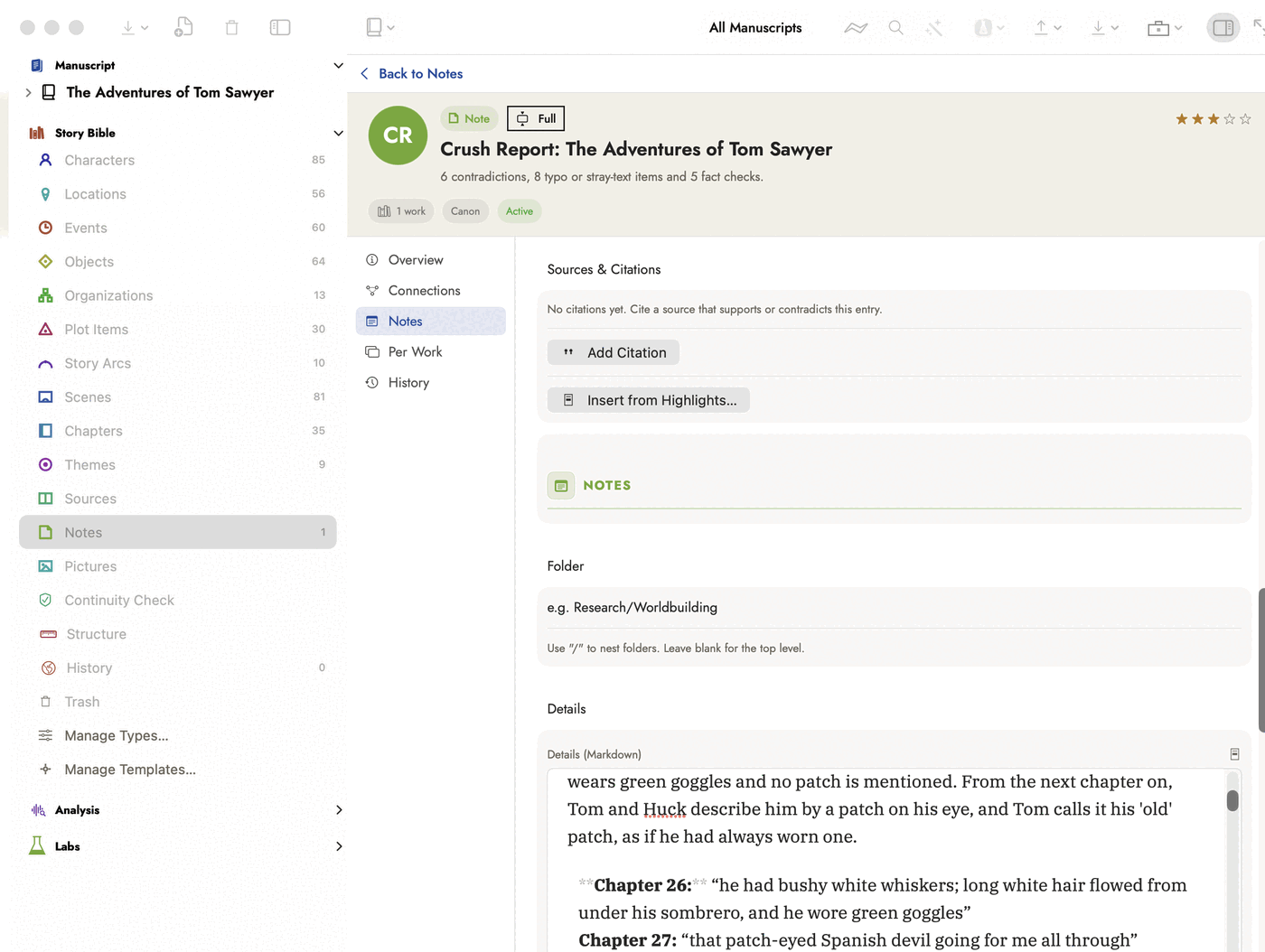 The counts of all three lists are in the summary line.
The report itself is markdown in the note's Details field, so you read it by
scrolling.
The counts of all three lists are in the summary line.
The report itself is markdown in the note's Details field, so you read it by
scrolling.
Contradictions usually sit chapters apart, so each section read also lists that section's checkable claims — dates, ages, durations, counts, places, who was present, physical details, spellings — and one last request compares the whole list with the whole book, checking each candidate against the page before reporting it.
Written by Analyze Manuscript with AI and both Re-analyze commands when Claude is the engine. Not written by Find Only What's Missing, or by the on-device model. It costs one more request, and each full read replaces the report rather than adding another; a Note you made yourself with the same name is left alone.
Review in Word
Open the report and choose Review in Word… from its Record Actions menu to save a Word copy of the manuscript marked up for review. Each contradiction becomes a margin comment on every side it quotes, numbered "(1 of 2)" and naming the other chapters. Each fact check and each typo that needs a decision becomes a comment with the concern or suggestion. A typo with one plain correction becomes a tracked change on the word itself, ready to accept or reject on Word's Review tab.
Comments are authored "Crush Review", so Word can filter them from your editor's. They sit on the whole paragraph holding the quote; a quote that can't be found goes on the first paragraph of its chapter. A correction that would cut through italics or bold becomes a comment saying what to change. Nothing in your manuscript in Sgeulai changes, and making the copy costs no requests: it reuses the report.
What a run costs, and the spending limit
Every command that sends a manuscript to Claude shows its likely cost before anything is sent — on every run, since the figure is different for every book and model. Analyze Manuscript with AI… has no confirmation of its own, so it shows the price in an alert headed Use Claude for “Analyze Manuscript with AI”?, with Continue and Cancel. The other four commands already ask before they run, so the price is the last paragraph of that dialog, and there's no second question.
Beneath it: where your spending limit will stop the run — with a warning when the limit is below the top of the estimate — and a warning when the credit you've recorded on the Usage tab looks too low to cover it.
How it's worked out. On your Mac, from the manuscript's length (roughly 2.9 characters to a token), with dollars per token taken from real runs of the app rather than list prices, because most of the bill is what the model writes back. It appears instantly, works offline, and doesn't depend on your account having credit. The range is wide on purpose: a memoir yields more per page than a novel, and a reply that comes back broken is paid for twice.
| On Claude Opus 5 | Measured on a 69,544-word novel | Estimate for 80,000 words |
|---|---|---|
| Analyze Manuscript with AI… | $6.31 | about $5–9 |
| Re-analyze, Inserting (analysis, then field fill) | $8.60 | about $7–13 |
| Propose Scene Splits… | $0.58 | under $1 |
Choosing Sonnet lowers the estimate for the reading part to about 40%, in line with its price — worked out, not measured. The field fill always reads with Opus and the scene split always uses Sonnet, whichever model you choose.
The spending limit is in Settings ▸ Usage, on by default at $15 a run. One command runs under one limit — Re-analyze, Inserting's analysis and field fill share it. It's checked before each request against Sgeulai's own running estimate, so requests already under way still finish and a run can end slightly over. A run that reaches it sends nothing more and keeps everything it had already written; the closing alert says which sections weren't read, that the Crush Report wasn't written, or that the field fill's remaining records weren't read. Run the command again to read what was missed — records already written aren't duplicated. Replay Archived AI Results… costs nothing and isn't limited.
What gets sent
Only the field-filling half of Re-analyze, Inserting New AI Results… leaves out chapters marked as front or back matter — a copyright page and an acknowledgements section have nothing to say about who is in the book, and filling their fields costs you money for no answer. Its discovery half reads the whole manuscript, front and back matter included, the same as the other three runs — the first analysis, replacing a previous run, and proposing scene splits.
The manuscript is uploaded once per run and the questions are asked against that single copy, rather than the book being re-sent for every question.
A note on trust
The analysis is a reader, not an authority. It is good at noticing that a character appeared in fourteen scenes and confident about things it has no way to know — and now that its output writes straight into your Story Bible with no review step, that confidence lands directly in your record. The archived raw response (above) is what lets you check its work after the fact, or recover from a run that got something wrong, rather than catching it before it's written.
The same thing, filed more than once
The most common way a reading is wrong isn't invention, it's duplication: the manuscript itself refers to something differently from one passage to the next, and each phrasing can come back as its own record — "Tom", "Tom the Florist" and "Tom Johanson" filed as three Characters instead of one. It isn't only people: a location called "the Beaches apartment" in one chapter and "our old place on Kippendavie" in another, or an organization named both "the paper" and "the Toronto Star," can just as easily come back twice. Scan a fresh run's results for this before trusting a count, a relationship, or a scene tally that assumes they're the same thing.
The fix is Merge — see The Story Bible's Merging duplicates section. It covers Character, Location, Event, Object and Organization records; Plot Items and Story Arcs aren't mergeable yet, and chapters and scenes never are, since combining two of those is an editing decision, not a bookkeeping one. Where it applies, merging is built for exactly this: the absorbed names stay attached to the surviving record as aliases rather than disappearing, so nothing that already refers to "Tom the Florist" breaks just because the record it points to is now named "Tom."